Most men over 50 are training for the wrong goal. They're chasing the body they had at 30. And that chase is exactly what's wrecking their knees, their shoulders, and their motivation.
Here's the real problem: the version of strength training most men learned — high volume, heavy load, push through the pain — was designed for 22-year-olds with fast recovery, high testosterone, and no accumulated wear on their joints. Running that same program at 52 doesn't make you tough. It makes you injured and frustrated.
Strength training for men over 50 isn't a scaled-down version of what you used to do. It's a different game with different rules. And the biggest rule change surprises most men: the best program isn't the most optimized one. It's the one you'll still be doing two years from now.
Why the Old Approach Keeps Failing You
You've probably tried to get back to lifting before. Maybe you ran a program you found online, or you went back to what worked in your 30s. It went well for a few weeks. Then something hurt. You backed off. You lost the momentum. Three months later you're starting over again.
This isn't a discipline problem. It's a biology problem — and a design problem.
After 50, your body loses muscle at roughly 1-2% per year if you're not actively fighting it — a process called sarcopenia. Research published in the Journal of Cachexia, Sarcopenia and Muscle confirms that this muscle loss accelerates without resistance training, and that it's directly tied to metabolic decline, joint instability, and reduced quality of life. It's not cosmetic. It's structural.
At the same time, testosterone is typically lower than it was at your peak, collagen synthesis slows down, and connective tissue takes far longer to recover than muscle does. You feel fine after a heavy session. Then two days later your elbow or your hip flexor sends you a bill.
The old program didn't fail because you got weak. It failed because it wasn't built for how your body works right now — and because it was built around someone else's idea of what you should do, not what you'd actually keep doing.
What Most Men Over 50 Try (And Why It Doesn't Last)
There are three traps men fall into when they try to rebuild muscle after 50.
The “back to basics” trap. You go back to exactly what you did at 30. Heavy load, low reps, ego on the bar, and joints that haven't been asked to move through their full range in two decades. Your muscles can handle more than your joints can. Something tears. You're out for six weeks.
The “just cardio” retreat. After the injury, you switch to the elliptical and some light walking. Your cardiovascular health improves slightly. Your muscle mass continues to drop. Your metabolism slows further. You've traded one problem for a worse one.
The “perfect program” trap. You find the optimal routine — the right exercises, the right sets, the right split — and force yourself through it. It's technically sound. You hate every minute of it. By week six, work gets busy, you miss a few sessions, and the whole thing quietly collapses.
None of these work because none of them solve the actual problem. Building and maintaining muscle requires progressive load applied consistently, for years. Keeping your joints healthy requires strength through their full range of motion. And neither happens if you dread showing up.
The Real Problem Isn't Your Age — It's Your Environment
Here's the reframe most men need: muscle loss after 50 isn't inevitable. It's the predictable output of an environment that asks nothing of your body.
Think about what most high-income men in their 50s actually do with their bodies all day. They sit. They commute. They sit some more. They eat convenient food on a schedule designed by their calendar, not their biology. The physical demands of their daily life dropped to near zero twenty years ago, and the body adapted accordingly.
Your body doesn't maintain what it doesn't need. If the environment never requires you to carry, push, pull, squat deep, or stabilize anything heavy, the machinery for doing those things quietly goes offline. Range of motion shrinks. Tendons stiffen. The joints lose the strength that used to protect them at the edges. That's not aging. That's adaptation.
This is the same argument we make about metabolic health across the board — and it applies just as directly to muscle and mobility. As we explain in why men over 40 can't out-exercise a broken metabolism, the issue is never willpower or effort. It's the environment your body is living inside every day. Change the environment, and the body changes with it.
Training is how you change the physical environment. But the way you approach it matters enormously.
How Strength Training After 50 Actually Works
The goal isn't to train like you're 30. The goal is to train in a way that builds muscle, protects your joints, and keeps you moving well for the next thirty years.
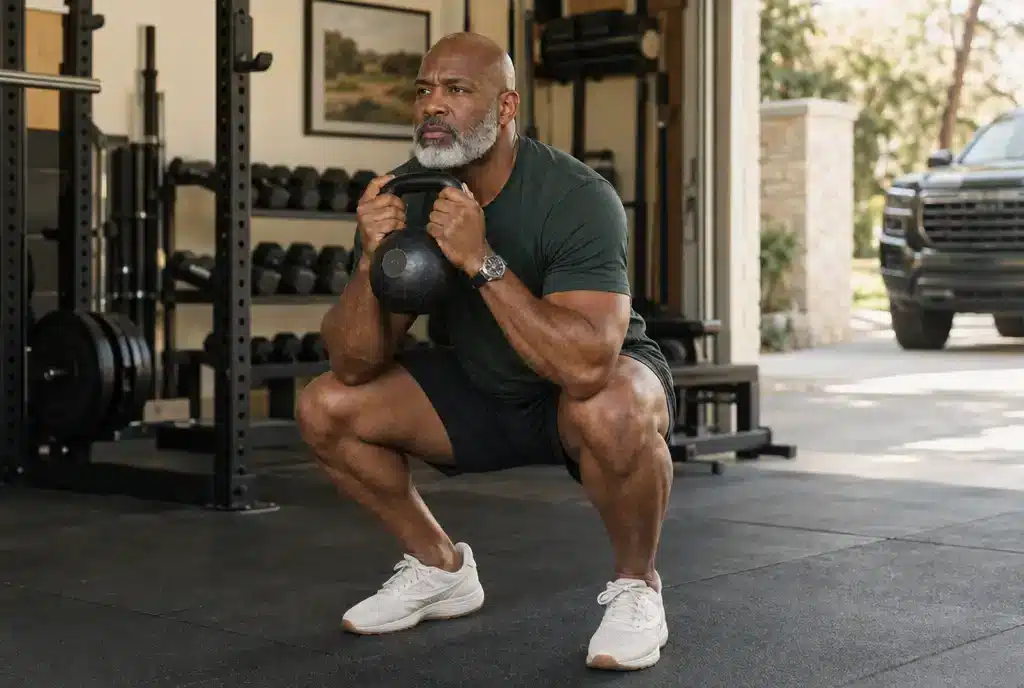
Consistency beats specificity. This is the principle everything else rests on. The “best” exercise you skip does nothing for you. A good-enough exercise you look forward to, done week after week for years, changes your body. At Xylem, we don't hand men a rigid routine. We help them find movements they actually enjoy and then build structure around those. The gym is a great place to do resistance training — the equipment makes it easy to load every muscle group and progress over time — and we encourage it for men who like it. But it's far from the only option. Resistance bands at home, kettlebells in the garage, hauling mulch and splitting wood in the yard, jiu-jitsu, rucking, swimming — your muscles don't know where the resistance comes from. They only know whether it showed up. Enjoyment isn't a soft extra. It's what makes consistency possible.
Mobility is a longevity tool, not a warm-up. Most men treat mobility as five minutes of stretching they skip when they're short on time. That's backwards. Joints get hurt at the edges — deep in a squat, reaching overhead, lunging for something. If you've never built strength in those positions, they're where you're weakest and most vulnerable. Training strength through the full range of flexion and extension — the approach popularized by Ben Patrick, the “Knees Over Toes Guy,” and his ATG method — builds resilience in exactly the positions most men avoid. A growing body of research also suggests that training muscles at long lengths is at least as effective for building muscle as training in shortened ranges, so you're not trading strength for mobility. You're getting both.
Load the muscle, respect the joint. Muscles still need progressive tension to grow. Joints need range of motion, control, and time to adapt. These aren't in conflict — but you have to be deliberate. Start end-range work with bodyweight or light load, earn the range first, then add weight gradually. Any exercise can be joint-friendly or joint-hostile depending on how you load it and how fast you progress.
Frequency over volume. Your muscles can still respond to training stimulus. Your connective tissue recovers more slowly. The solution is more frequent, lower-volume sessions rather than one brutal session per week. Mobility work in particular responds well to short, frequent doses — ten to fifteen minutes most days beats an hour once a week.
Rep ranges that respect biology. Research from McMaster University has shown that meaningful muscle hypertrophy occurs across a wide range of rep counts — from 5 reps to 30 reps — as long as the set is taken close to muscular failure. This is good news. It means you can build real muscle with loads your joints can handle. You don't need to max out. You need to work hard enough that the last two or three reps are genuinely difficult.
Protein is non-negotiable. Muscle protein synthesis — the process your body uses to actually build new muscle tissue — becomes less efficient after 50. You need more protein per pound of bodyweight to get the same response, not less. A reasonable target is close to one gram per pound of your goal bodyweight, distributed across the day. This isn't a supplement pitch. It's physiology. If your protein intake is low, no training approach will fully compensate.
Sleep is when muscle gets built. Growth hormone peaks during deep sleep. Testosterone follows a similar pattern. If you're sleeping five or six hours, you're running the recovery process on a fraction of its capacity. Training gives the signal. Sleep is where the body actually executes.
What Does This Look Like in Real Life?

We don't prescribe a universal routine, because the right routine is the one that fits your life and that you'll actually keep. But most sustainable weeks share the same building blocks:
Resistance work, two to four times a week. Pick movements you enjoy that cover the basics: something you push, something you pull, something for your legs, and something you carry or hinge. If you like the gym, use it — it's the easiest place to add load gradually. If you'd rather stay home, a set of resistance bands, a pair of dumbbells, or your own bodyweight can do the job. Even real-world work counts: carrying bags of soil, digging, moving furniture, and heavy yard work are all resistance training your body understands. Work hard on the last few reps of each set and add load or reps gradually over time.
End-range mobility and joint strength, most days. Short, consistent sessions that build strength at the edges of your range. Common examples from the ATG / Knees Over Toes style of training include tibialis raises, backward walking or sled drags, deep split squats with the knee traveling over the toe, slant-board squats, controlled deep squat holds, and loaded stretches for the hips and hamstrings. Start easy, progress slowly, and stay pain-free.
Movement you love, as often as possible. Walk. Swim. Hike. Roll. Play pickleball. Work in the yard. Play with your kids or your grandkids. These aren't “off” days — they keep the joints moving and the metabolism ticking without adding to your recovery debt. The more of your week you spend doing physical things you genuinely enjoy, the less exercise feels like a chore you have to schedule.
No five-day bro splits. No two-hour sessions. No guilt over doing a different exercise than the program in a magazine. Just a structure you can live with, built from things you actually want to do.
What Changes When the System Works
The men who get this right describe the same things. More energy by mid-morning. Less joint pain because the muscles and tendons around the joint are finally doing their job. Moving more freely — getting down to the floor and back up without thinking about it. Better sleep. Clothes fitting differently. The ability to keep up with their kids instead of watching from the sidelines.
Kevin R, a client who went through our program, put it this way: he wanted to leave the park when his kids were tired, not when he was. That became his metric. Not the scale. Not a PR on the squat. Whether he could be fully present in his own life.
Phil L — a Doctor of Physical Therapy and black belt in jiu-jitsu — had cycled through extreme approaches for years before building something that actually held. His insight after getting it right: “I never had a long-term goal or an idea of what I wanted my life to look like past the short-term target. That's what set me up to fall off.” He's down over 60 pounds and built a sustainable routine around swimming and lifting — two things he genuinely enjoys — that fits his actual life. He stopped treating exercise as punishment for eating and started treating it as maintenance for a body he wanted to keep.
That's the shift. Training for longevity instead of training to look a certain way in the mirror by a certain date.
The Muscle and Mobility You Build Now Are Infrastructure
Muscle is metabolically active tissue. It burns calories at rest, regulates blood sugar, protects joints, and keeps your hormonal environment functioning. Mobility — real, strong range of motion — is what lets you keep using that muscle without getting hurt. Losing either isn't just an aesthetic problem. It's a health problem that compounds every year you let it slide.
But here's the thing: sarcopenia is largely reversible with consistent resistance training. The National Institute on Aging is clear that strength training remains one of the most effective interventions for maintaining functional capacity as we age.
You're not rebuilding a younger body. You're building infrastructure for the next chapter of your life. The man who can hike, get down on the floor with his grandkids, stay sharp under pressure, and sleep through the night isn't on some elite program. He found a way to train that he enjoyed, that respected his biology, and he never stopped.
That's available to you. But it requires a different approach than the one that's been failing you.
If you want to know where your biology actually stands right now — what's working, what's not, and what a real plan looks like built around your specific numbers — that's what our free Baseline call is for. No pressure, no pitch. Just an honest conversation about what's actually going on and whether we can help.
Book Your Free Baseline Call
Frequently Asked Questions
How often should a 50-year-old man lift weights? For most men over 50, two to four resistance sessions per week is the sweet spot, paired with short mobility work on most days. But the honest answer is: as often as you'll consistently do it. Two sessions a week sustained for years beats four sessions a week abandoned after a month.
What exercises should men over 50 be doing? There's no magic list. The best exercises are the ones you enjoy enough to keep doing. Aim to cover the basic patterns — push, pull, squat or lunge, hinge, and carry — with whatever tools you like, and add end-range mobility work for the knees, hips, ankles, and shoulders. Consistency matters far more than exercise selection.
Do I need a gym to build muscle after 50? No. The gym is a great tool — it makes it easy to load every muscle group and progress steadily, and many men enjoy it. But muscle responds to resistance, not to a location. Resistance bands, dumbbells or kettlebells at home, bodyweight training, and physically demanding activities like yard work can all build and maintain muscle. The best setting is the one you'll keep coming back to.
What is “Knees Over Toes” or ATG training? It's an approach popularized by Ben Patrick that focuses on building strength through a joint's full range of motion, including deep knee flexion with the knee traveling past the toes. The idea is that joints become resilient when they're strong at their end ranges, not when those ranges are avoided. Typical exercises include tibialis raises, backward walking, deep split squats, and slant-board squats, progressed slowly from bodyweight.
What is the 3-3-3 rule for working out? Definitions vary, but it's commonly described as three exercises, three sets each, three days a week. It's a useful minimum starting point for men returning to strength training after 50 because it keeps volume low enough to recover from and builds the consistency habit before adding complexity. Fill those three exercises with movements you actually like doing.
What drink builds muscle fast? There's no drink that builds muscle — that's food marketing. What builds muscle is consistent resistance training paired with adequate protein intake, and the best “drink” for recovery is water. A protein shake can be a convenient way to hit your daily protein target if whole food isn't practical, but the protein is doing the work, not anything else in the product.
Is strength training after 50 safe for joints? Yes — and done correctly, it protects joints over time by building the muscle and tendon strength that stabilizes them. The key is building strength through your full range of motion gradually, starting light in end-range positions, using rep ranges that allow controlled movement, and resisting the urge to max out. Joints don't recover at the same rate as muscle at this age, so the strategy is to build them up patiently rather than grind through them.
Does testosterone affect muscle building after 50? Significantly. Testosterone is a primary driver of muscle protein synthesis, and levels decline gradually with age. This doesn't make building muscle impossible, but it does mean recovery is slower and protein intake needs to be higher than it was at 30. For men with clinically low testosterone, addressing that through proper evaluation can meaningfully change how the body responds to training — one of the reasons men over 50 benefit from physician-led support, not just a new program.